
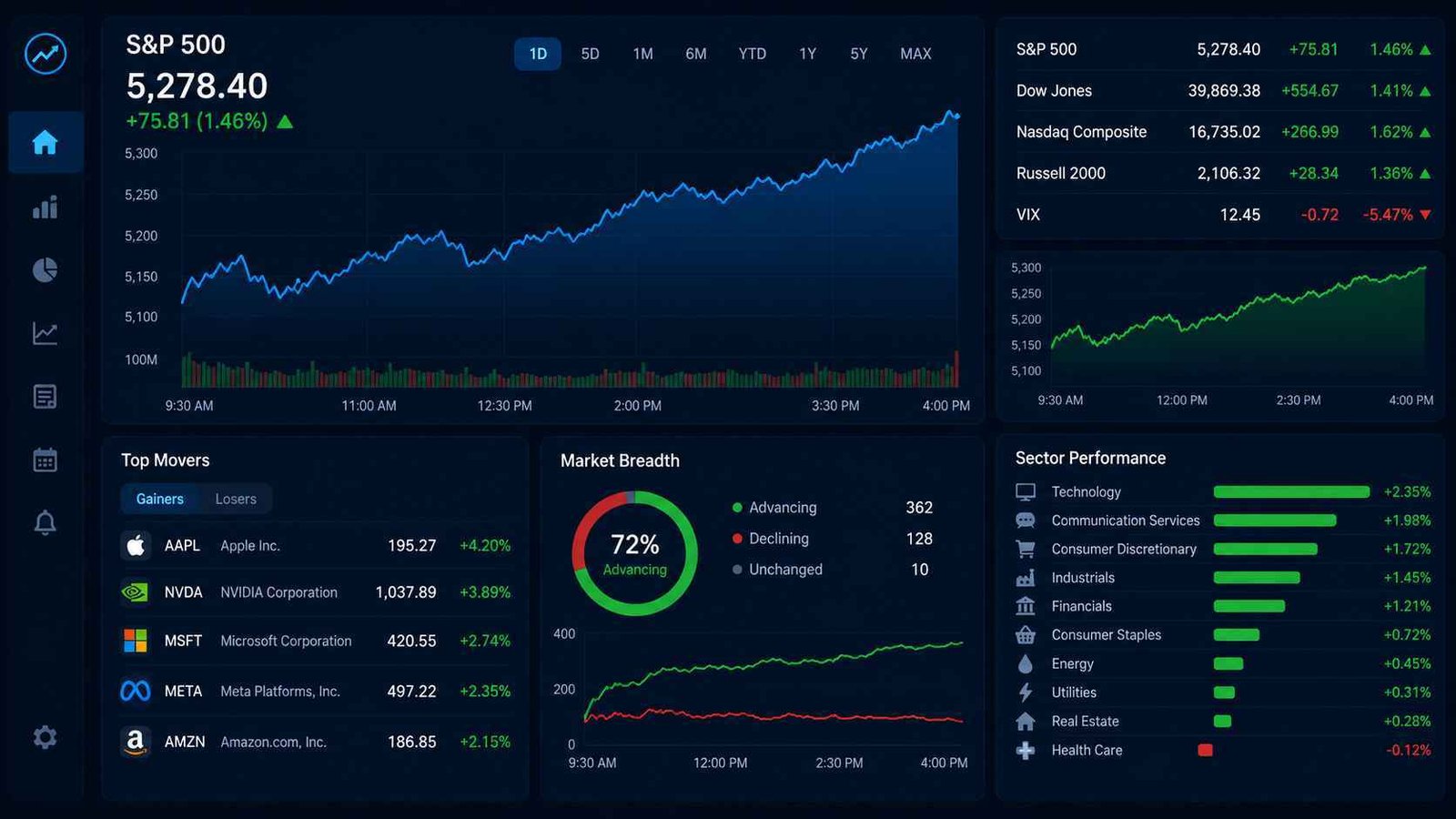

Most people check the S&P 500 the same way they check the weather. A quick glance, a number, and move on. But when the index dropped nearly 20% in 2022 or bounced back sharply after the 2020 crash, that single number wasn’t telling the full story. What was happening underneath mattered far more.
This guide breaks down what the S&P 500 actually is, what moves it, and how coverage like FintechZoom.com helps readers make sense of the bigger picture, not just the headline number.
What Is the S&P 500?
The S&P 500 tracks 500 large, publicly traded US companies across multiple sectors. It has been the go-to market benchmark since 1957. When someone says “the market is up today,” they are almost always talking about this index.
That said, calling it “the market” is not quite right. It covers a specific slice of large American companies. Thousands of smaller businesses, foreign stocks, and mid-sized companies are not in it. Still, because these 500 companies make up such a large share of total US market value, the index carries serious weight.
How Companies Get Selected
There is no automatic entry. The S&P Index Committee reviews companies based on market cap, US domicile, share liquidity, and recent profitability. A company needs at least four consecutive quarters of positive earnings just to be considered. You can check the full eligibility criteria before a company even gets considered.
So even well-known brands sometimes don’t make the cut. Too small, not profitable enough, or recently listed. And once a company is in, it is not permanent. Mergers, bankruptcies, or a shrinking market cap can trigger removal.
One thing many people don’t realize: when a new stock gets added to the index, every fund that tracks the S&P 500 has to buy it. That buying pressure alone can push the stock price up before it even officially joins.
Why It’s Not “The Whole Market”
There are over 5,000 publicly traded companies in the US. The S&P 500 covers 500 of them, the big ones. Smaller companies live in indexes like the Russell 2000. International stocks are in a completely different category.
This is worth keeping in mind. A day when the S&P 500 is flat doesn’t mean every stock sat still. Small caps might be getting hammered, or foreign markets might be having a great session. The S&P 500 tells one part of the story.
How FintechZoom.com Covers the S&P 500
Raw market data doesn’t tell you much on its own. Knowing the index moved up 1.2% on a Tuesday is a fact. Understanding why it moved and what that might mean is where the actual value lies.
What Kind of Information You’ll Find
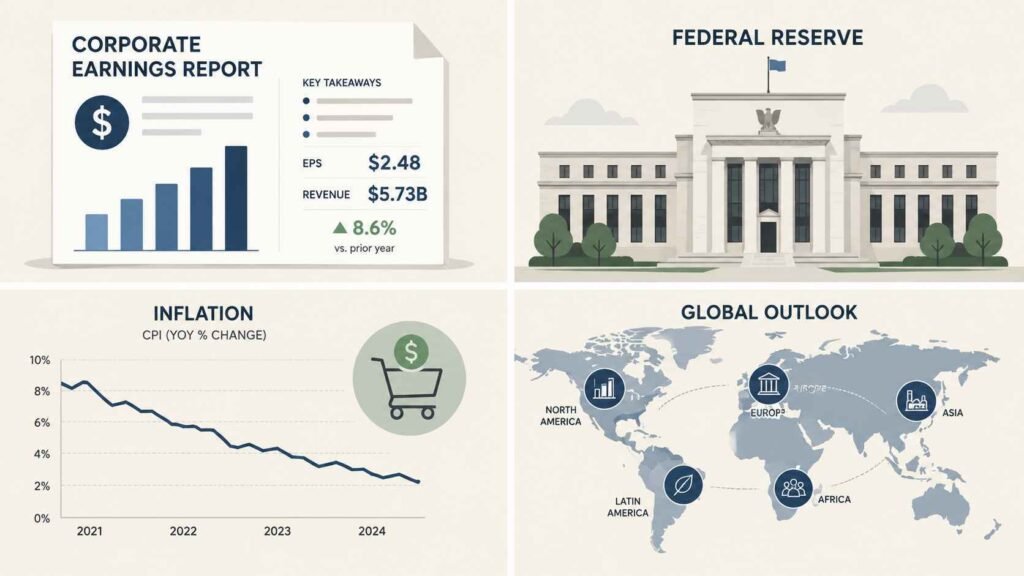
FintechZoom.com SP500 coverage connects market numbers to the events behind them. That means earnings results from major companies, Fed decisions, inflation prints, and shifts happening at the sector level.
Take earnings season. Dozens of major companies report within weeks of each other. Some beat expectations, some miss badly. A platform that tracks how those results move the broader index gives readers something far more useful than a price chart.
Same goes for economic data. Markets often move on inflation reports before the Fed has even responded. Coverage that explains that chain reaction helps readers understand what they are actually watching.
Who Actually Uses This Coverage
The audience is more varied than you might expect. Finance students, portfolio managers, business professionals tracking industry trends, and everyday readers who want to understand what the news is actually saying about the economy all end up here.
The index is broad enough that almost any big economic story eventually touches it. If you want a broader look at how the platform approaches equities overall, the FintechZoom stock market guide covers that in more detail.
The Sectors Driving S&P 500 Performance
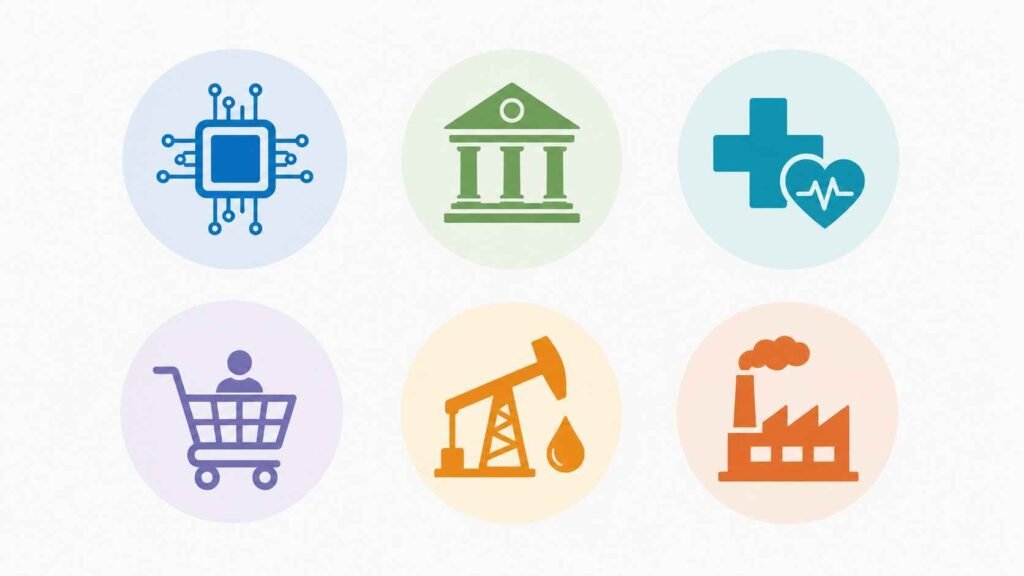
The index spans many industries, and they don’t move as one. On any given day, technology might be climbing while energy is pulling back. Knowing which sectors are leading and which are lagging tells you a lot about what the market is actually reacting to.
Technology’s Outsized Role
Over the past decade, tech has grown into the single largest chunk of the S&P 500 by market value. That means a rough week for a few giant tech companies can drag the whole index down, even if the other 480 stocks are doing fine.
This wasn’t always the case. Tech’s weight has grown as software, semiconductors, and cloud businesses expanded. When the Fed raises rates, growth stocks like tech tend to get hit first because future earnings become less valuable in a high-rate environment. When rates ease, tech usually bounces back hard.
Financials, Healthcare, and Consumer Stocks
Banks and insurance companies are closely tied to interest rates. Higher rates generally help banks earn more on loans. But if rates stay high for too long and the economy slows, loan defaults start creeping up. Watching financials gives you a decent read on what the broader economy is doing.
Healthcare behaves differently from most other sectors. People still need prescriptions and medical procedures whether the economy is booming or contracting. That’s why healthcare is often seen as a defensive play when investors get nervous.
Consumer stocks split into two camps. Staples like food and cleaning products hold up well in downturns because people keep buying them regardless. Discretionary items like travel, restaurants, and luxury goods are the first thing households cut when budgets tighten.
Energy and Industrials
Energy stocks move a lot with oil and gas prices. A conflict in a major oil-producing region, an OPEC decision, or a sudden demand shift can send energy stocks swinging quickly, which shows up in the index.
Industrials tend to reflect where we are in the economic cycle. Strong manufacturing data, infrastructure spending, and business investment push them up. When growth slows, orders dry up and industrials feel it early.
What Actually Moves the S&P 500?
Every move in the index has a reason behind it. Sometimes that reason is obvious. Sometimes it takes a few days for the market to process what just happened.
Corporate Earnings Season
Four times a year, public companies report their results. This stretch is called earnings season, and it is one of the most active periods in the market.
Here is the key thing to understand: markets are forward-looking. Stock prices already reflect what investors think a company will earn. So when results come in, the question isn’t whether the company made money. It’s whether it made more or less than what was already priced in. A company can post record profits and still see its stock fall if Wall Street was expecting even better numbers.
When enough big companies surprise in the same direction, it moves the whole index.
Interest Rates and Fed Decisions
The Federal Reserve sets the benchmark interest rate in the US, and that rate touches almost everything. Higher rates mean more expensive mortgages, business loans, and credit card debt. That slows spending, squeezes corporate margins, and often makes bonds look more attractive than stocks.
Lower rates do the opposite. Borrowing gets cheaper, businesses invest more, consumers spend more, and stocks tend to climb.
What’s interesting is that the actual Fed decision often matters less than what investors expect beforehand. Markets frequently move weeks before a Fed meeting just on speculation about what the central bank will do.
Inflation Data and Economic Reports
The Consumer Price Index, jobs reports, and retail sales figures all hit on a regular schedule and often move markets noticeably. Not because the numbers themselves are dramatic, but because they shift what investors expect the Fed to do next.
A hotter-than-expected inflation print might push rate-cut expectations further out. That alone can knock stocks down. A strong jobs report might suggest the economy is holding up better than feared, or it might signal that inflation will stick around longer. Markets have to process all of that quickly.
These reports don’t move markets in isolation. They add to a running picture of where the economy is headed.
Geopolitical Events
Not every headline moves markets. But when a conflict threatens oil supply, when major trade routes get disrupted, or when sanctions hit industries that touch global supply chains, markets react.
Energy is usually the first sector to move when geopolitical tension rises in oil-producing regions. After that, it depends on what’s actually at risk. Defense stocks sometimes rise. Travel stocks can drop. The index absorbs all of it.
How to Read S&P 500 Trends
A 2% drop sounds like a lot. Over a full year, it barely shows up. How you read a market move depends entirely on the timeframe you are looking at.
Daily Moves vs Long-Term Trends
Markets react every single day. Sometimes to news. Sometimes to rumor. Sometimes for reasons that nobody can fully explain. Getting caught up in daily swings, either panicking or celebrating, usually ends badly.
The clearer picture comes from zooming out. Months and years show whether the market is in a real uptrend, a genuine decline, or just moving sideways with a lot of noise. One bad session tells you almost nothing. A pattern over six months tells you quite a bit.
Market Breadth
When the index rises, the follow-up question is: how many stocks are actually going up?
Sometimes the index gains because five or six giant companies had a good day while most of the 500 were flat or slightly down. That is a narrow rally, and it tends to be fragile. A broad rally where hundreds of stocks are climbing together is a healthier signal.
Analysts track this as market breadth. It is one of the better ways to judge whether an index move has real conviction behind it or is just being dragged by a few heavyweights.
Sector Rotation
As economic conditions change, investors move money between sectors. This is called sector rotation, and spotting it early can tell you a lot about where market sentiment is heading.
When money flows into defensive sectors like utilities, healthcare, and consumer staples, it usually means investors are getting cautious. When money pours into technology, financials, and consumer discretionary, it often signals confidence in growth. These shifts don’t happen overnight, but watching them over a few weeks gives a clearer read on where the market’s head is at.
S&P 500 vs Other Major Indexes
The S&P 500 is not the only benchmark worth watching. Comparing it to others fills in the gaps.
S&P 500 vs Dow Jones
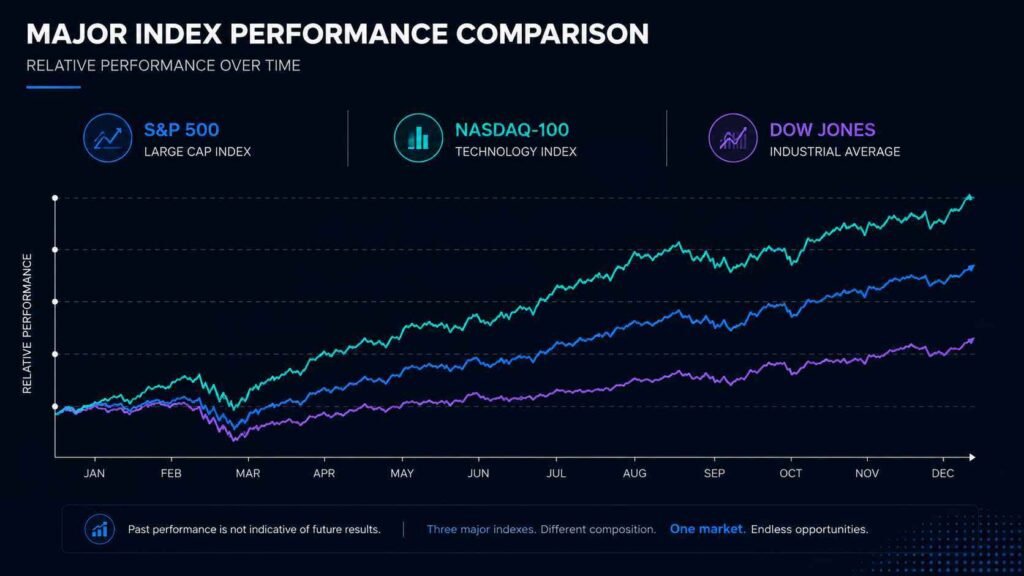
The Dow Jones Industrial Average covers just 30 companies and is price-weighted, meaning a stock with a higher share price has more influence regardless of the company’s actual size. Most analysts consider it a less accurate reflection of the overall market than the S&P 500.
The Dow gets attention mainly because of its age and name recognition. But for a real read on how large US companies are doing, the S&P 500 is the more reliable tool.
S&P 500 vs Nasdaq
The Nasdaq Composite lists thousands of companies but is heavily concentrated in technology. When tech is booming, the Nasdaq outperforms the S&P 500 by a wide margin. When tech gets hit, it falls harder too.
The S&P 500’s wider sector spread smooths out some of that volatility. It is why analysts use it as a general market benchmark rather than a sector gauge. For a deeper breakdown of how the Nasdaq works and what drives it, the FintechZoom.com Nasdaq guide covers it properly.
S&P 500 vs Russell 2000
The Russell 2000 covers 2,000 smaller companies. Small caps are more sensitive to domestic economic conditions, tend to carry more debt, and are often hit harder when borrowing costs rise.
Watching the Russell 2000 alongside the S&P 500 can reveal something useful. When large caps are rising but small caps are struggling, it sometimes signals that confidence is narrow, concentrated in the biggest players rather than spread across the whole economy.
Common Mistakes People Make
A few misunderstandings come up constantly with the S&P 500.
The biggest one is reacting to daily moves as if they mean something. They usually don’t. Markets are noisy, and a single session rarely tells you where things are headed.
Second is thinking the index covers everything. It doesn’t. You are looking at 500 large US companies. Thousands of smaller businesses, foreign stocks, and mid-caps are invisible in this benchmark.
Third is missing the concentration issue. The S&P 500 is weighted by market cap, so the biggest companies have the most influence. In recent years, a handful of tech giants have made up a disproportionate share of the index’s total value. When those few companies have a bad stretch, the index feels it heavily even if most other stocks are doing fine.
Knowing what the index actually measures, and what it leaves out, makes it a much more useful tool.
FAQs
What is FintechZoom.com SP500? FintechZoom.com SP500 is the platform’s coverage of the S&P 500 Index. It covers index performance, sector activity, economic events, and the broader market trends that influence how the index moves.
Why is the S&P 500 important? It tracks 500 large US companies across many industries, making it one of the broadest and most reliable snapshots of large-cap American market performance. Investors, fund managers, and economists use it as a standard benchmark.
How many companies are in the S&P 500? 500 publicly traded US companies. The list changes periodically as companies are added or removed based on eligibility criteria.
Does the S&P 500 represent the entire stock market? No. It covers large-cap US companies only. Thousands of smaller US companies, mid-caps, and all international stocks are outside its scope.
How often does the index composition change? There is no fixed schedule. Changes happen throughout the year when a company no longer meets the criteria or when the committee decides an adjustment is needed.
Can daily S&P 500 movements predict future performance? Not reliably. Short-term moves reflect immediate reactions to news and sentiment. Longer trends over months and years are far more meaningful for understanding market direction.