


Nasdaq does not need an introduction for most investors. But understanding it well enough to actually use it? That is a different conversation.
The index gets mentioned constantly. In news headlines, earnings calls, portfolio updates. Yet plenty of investors tracking it daily still have a surface-level grasp of how it works, what separates its two main indices, and what genuinely moves it beyond the obvious names like Apple and Nvidia.
FintechZoom.com covers Nasdaq extensively. Real-time data, market analysis, stock tracking. But the platform itself comes with some confusion worth clearing up before you rely on it.
This guide starts with Nasdaq, because that is the real subject here. Then it gets into what FintechZoom actually offers, what it does well, and where you should not expect it to replace proper research tools.
Table of Contents
What the Search Term “FintechZoom.com Nasdaq” Actually Means
Search terms tell you a lot about what people actually want. This one is interesting because it combines a brand name with one of the most watched financial markets in the world. That combination creates a specific kind of search intent worth addressing upfront.
People searching “FintechZoom.com Nasdaq” are generally not looking for just one thing. Some want to understand what Nasdaq is and find a readable source to follow it. Others already know the exchange and are trying to figure out whether FintechZoom is a reliable platform for tracking it. A smaller group is looking for real-time data, stock analysis, or market context they can act on.
What this search term is not is a signal that FintechZoom and Nasdaq have some official relationship or formal partnership. They do not. FintechZoom.com is an independent financial news and data platform. Nasdaq is a stock exchange. The connection between them is that FintechZoom covers Nasdaq extensively, the same way any financial media outlet covers a major market. Understanding that distinction matters before you use either one.
So think of it this way. Nasdaq is the market. FintechZoom is one of several platforms people use to follow it. This article focuses on both, starting with the one that actually moves your money.
What Is Nasdaq? The Exchange Behind the Index
Nasdaq, short for National Association of Securities Dealers Automated Quotations, is the world’s first fully electronic stock exchange. Founded in 1971, it is the second largest stock exchange globally by market capitalization and is best known for listing major technology companies including Apple, Microsoft, Amazon, and Nvidia. Unlike traditional exchanges, it has never had a physical trading floor. Everything runs electronically, and that has defined its identity from day one.
Before tracking any market, it helps to understand what you are actually looking at. Nasdaq is not just a number that goes up and down on a screen. It is a fully functioning stock exchange where thousands of companies list their shares for public trading.
Nasdaq officially launched on February 8, 1971, introduced by the National Association of Securities Dealers. It was the first time trades could be managed through computers instead of relying solely on physical exchanges. Before Nasdaq existed, stock trading meant physical trading floors, in-person brokers, and significant delays between orders and execution. The shift was not small. It changed how markets operated at a structural level.
Over time Nasdaq became the natural home for technology companies. Apple, Microsoft, Amazon, Nvidia, Meta. These are not Nasdaq listings by coincidence. The exchange’s electronic foundation made it attractive to companies that were themselves built on technology. That concentration is what gives Nasdaq its distinct character as a market today.
When people refer to Nasdaq in a financial context they are usually referring to one of its two main indices, the Nasdaq Composite or the Nasdaq-100. Those measure how listed companies are performing collectively. People mix up the exchange and the index constantly. They are related but they are not the same thing.
Nasdaq Composite vs Nasdaq-100: What Each One Tracks
Most people use “Nasdaq” as a single term but there are actually two distinct indices that investors follow, and they measure very different things. Knowing which one you are looking at changes how you interpret market movements.
The Nasdaq Composite is the broader of the two. It tracks virtually every company listed on the Nasdaq exchange, spanning thousands of stocks across technology, biotechnology, retail, healthcare, and other sectors. Small caps, mid caps, mega caps. All of them feed into this index. When you see a general headline about “Nasdaq up 1.2% today” that figure almost always refers to the Composite.
Narrower and more concentrated, the Nasdaq-100 tracks the 100 largest non-financial companies listed on the exchange. No banks, no insurance firms, no financial services companies. Just the biggest names in technology, consumer services, industrials, and healthcare. Apple, Microsoft, Nvidia, Amazon, Meta. These companies carry significant weight inside the Nasdaq-100 because the index is weighted by market capitalization, meaning larger companies move it more than smaller ones.
All Nasdaq-100 companies are also part of the Composite, but the reverse is not true. A small biotech startup listed on Nasdaq appears in the Composite but never in the Nasdaq-100 unless it grows into one of the top 100 non-financial companies on the exchange.
FintechZoom covers both indices, so when you use the platform it is worth checking which one a particular chart or data point is referencing before drawing conclusions from it.
What Drives Nasdaq? Key Sectors and Market Forces
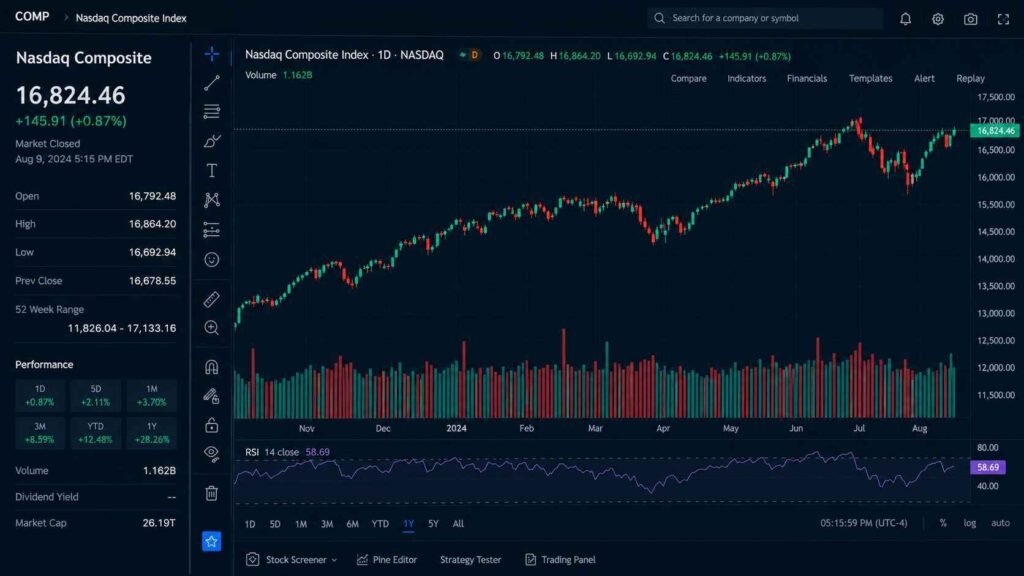
Nasdaq does not move randomly. Behind every significant swing there are identifiable forces at work. Understanding them changes how you read the market.
Technology is the dominant sector. It accounts for a substantial portion of the Nasdaq Composite’s total weight, and even more so within the Nasdaq-100. That concentration means when major tech companies report strong earnings, the index tends to rise. When they disappoint, the index feels it quickly. Apple, Microsoft, Nvidia, and Amazon collectively carry enough market capitalization to move the entire index in either direction on any given day.
Interest rates are another significant driver, and this one catches newer investors off guard. Nasdaq-listed companies, particularly in technology and growth sectors, tend to be valued based on future earnings rather than current profits. When interest rates rise, those future earnings are worth less in today’s terms. That is why aggressive rate hikes by the Federal Reserve have historically put pressure on Nasdaq more than on indices like the Dow Jones, which is heavier in traditional industries with more immediate cash flows. Rate cuts tend to have the opposite effect, and when borrowing costs fall, domestic small-cap stocks in the Russell 2000 often benefit even more directly than Nasdaq-listed growth names.
Earnings season matters enormously. Four times a year, major Nasdaq companies report their quarterly results. Those reports, and more importantly the guidance companies give about future performance, routinely trigger sharp index movements. A single earnings miss from a company with significant index weighting can pull the entire Nasdaq lower within hours.
Beyond company-specific results, broader economic signals play a role. Inflation data, employment figures, consumer spending reports, and geopolitical developments all feed into investor sentiment around growth stocks. Nasdaq is particularly sensitive to shifts in that sentiment because growth-oriented companies are priced with optimism baked in. When that optimism fades, valuations adjust fast.
Artificial intelligence has been a notable driver of Nasdaq performance in recent years. Investment flowing into AI infrastructure, semiconductors, and software has lifted companies directly involved in that space. That does not mean the trend continues forever, but it explains a lot of what you see when you look at Nasdaq charts from 2023 onward.
If you want to see how Nasdaq compares to a broader benchmark, our FintechZoom.com SP500 guide breaks down the differences and what each index actually tells you.
How FintechZoom.com Covers Nasdaq and What It Offers
FintechZoom.com is a financial news and data platform. Its Nasdaq coverage sits at the core of what the site does, and for good reason. Nasdaq is where the majority of investor attention flows when people are tracking technology, growth stocks, and innovation-driven markets.
At its most basic level, the platform gives users access to Nasdaq market data presented in a readable format. Stock prices, index movements, earnings coverage, and sector analysis are all part of what you find when you navigate to its Nasdaq section. The approach is built around accessibility. Raw data from financial exchanges can be difficult to interpret without context, and FintechZoom attempts to bridge that gap by pairing numbers with explanations.
For Nasdaq specifically, a few things stand out about how the platform presents information. Market news is filtered and presented with context rather than just headlines. When a Federal Reserve decision moves tech stocks, the coverage explains the connection rather than simply reporting the price change. That added layer is what separates it from platforms that display data without interpretation.
Charting tools are available on the platform for tracking individual Nasdaq-listed stocks and the broader indices. Users can look at price history, spot trends over different timeframes, and apply basic technical indicators. These tools are functional for research purposes, though they are not as advanced as dedicated charting platforms.
The platform also covers earnings reports for major Nasdaq companies. During earnings season, that coverage becomes particularly active. Results from companies like Apple, Nvidia, and Microsoft are covered with breakdowns that go beyond the headline numbers, touching on revenue segments, guidance, and what analysts are watching.
One thing worth stating clearly is that FintechZoom.com is a media and data platform, not a brokerage. You cannot execute trades through it. What it offers is information and analysis that investors can use as part of their broader research process.
The FintechZoom Naming Confusion You Should Know About
If you have searched for FintechZoom and ended up on a site that looked slightly different from what you expected, you are not alone. This is one of the most practically useful things to understand before relying on any platform carrying the FintechZoom name.
Multiple websites operate under similar branding. FintechZoom.com, FintechZoom.io, FintechZoom.org, fintechzom.com, fintechzoompro.com, nasdaqfintechzoom.com. The list goes on. These are separate websites. Some are independent platforms that built their own content and identity. Others are lookalike sites that borrowed the branding to capture search traffic. Not all of them are affiliated with each other, and the quality and accuracy of content varies significantly between them.
FintechZoom.com is the original and most established of the group. It has been active longer, carries more content, and is the platform most people are referring to when they mention FintechZoom in a finance context. FintechZoom.io operates differently. It positions itself more as a financial education platform, offering structured learning content rather than breaking news and market data.
The practical risk here is straightforward. A reader searching for Nasdaq analysis on FintechZoom might land on a copycat domain, read content that looks credible, and make research decisions based on it without realising the source is not the platform they intended to visit. In finance, that distinction matters.
Before using any FintechZoom-branded site for market research, check the exact domain in your browser. Verify that the content is dated, sourced, and written with clear authorship. A platform worth using for financial research should be transparent about who is writing its content and when it was last updated.
How Investors Actually Use FintechZoom for Nasdaq Research
Most investors do not rely on a single platform. They use several, each for a different purpose. FintechZoom typically sits early in that process. When a Nasdaq stock moves sharply or an index swings without an obvious reason, it is one of the first places people check for a quick, readable explanation. That speed and clarity has real value before you go deeper elsewhere.
Beyond breaking news, the platform works well for routine monitoring. Tracking specific stocks, checking index movements, reading earnings coverage when results drop. Nothing complex, just staying informed without having to piece together information from multiple sources every morning.
Where it has limits is in depth. SEC filings, official earnings transcripts, and brokerage analyst reports carry more weight than any financial media platform. Experienced investors treat it as a starting point. Deeper stock market research happens elsewhere.
What FintechZoom Does Not Replace (Honest Limitations)
No financial platform does everything well, and FintechZoom is no exception. A few limitations are worth knowing before you build it into your research process.
Data sourcing is not always transparent. The platform aggregates information from various sources but does not consistently cite where specific figures or analysis come from. For casual reading that is fine. For serious research where you need to verify a number or trace a claim back to its origin, that lack of transparency creates friction.
It is also not a substitute for professional-grade tools. Investors who need deep quantitative analysis, institutional-level risk modelling, or advanced backtesting will find FintechZoom insufficient for those purposes. Platforms like Bloomberg or Morningstar exist for a reason, and the gap between them and a financial media site is significant.
Portfolio tracking is not part of what it offers. You cannot input your holdings, monitor performance over time, or run scenario analysis on your positions. It is purely informational.
Use it for what it does well. Market context, earnings coverage, sector news, and a readable entry point into Nasdaq data. Expect more than that and it will fall short.
Nasdaq Investing: What New Investors Should Understand First
Nasdaq gets a lot of attention because of the companies it houses. Apple, Nvidia, Microsoft, Amazon. Names that dominate financial headlines and social media conversations about investing. That attention pulls in a lot of new investors, which is fine, but the index has characteristics that are worth understanding before you put money anywhere near it.
The first thing to grasp is volatility. Nasdaq-listed companies, particularly in the technology sector, tend to swing harder than stocks on other exchanges. Growth-oriented companies are priced with future expectations built in, which means sentiment shifts can move prices significantly even when nothing fundamental has changed at the company level. A new investor who is not prepared for that can make emotional decisions at exactly the wrong moments.
Concentration is another factor. The Nasdaq-100 in particular is heavily weighted toward a small number of very large companies. When those companies perform well the index looks impressive. When they face headwinds, the index drops sharply. That concentration is not a flaw but it is something to account for when thinking about how much exposure you want to a single sector or group of companies.
For investors who want Nasdaq exposure without the complexity of picking individual stocks, index funds and ETFs that track the Nasdaq-100 or Nasdaq Composite are a straightforward option. These allow you to invest in the broad performance of the index rather than betting on individual companies. Expense ratios on these funds vary, so it is worth comparing costs before choosing one.
One thing that gets overlooked by new investors is the difference between following Nasdaq and investing in it. Reading coverage on platforms like FintechZoom, checking charts, and staying current on tech sector news is valuable. But none of that replaces having a clear investment strategy, understanding your own risk tolerance, and ideally speaking with a licensed financial advisor before making significant decisions.
Nasdaq is not a guaranteed path to returns. Like any market it goes through extended periods of decline. The dotcom crash of the early 2000s wiped out a significant portion of Nasdaq’s value and took years to recover. Understanding that history does not make investing in it wrong, but it makes informed investing considerably more likely.
FAQ
Is FintechZoom.com the same as FintechZoom.io? No. They are separate websites. FintechZoom.com focuses on financial news and market data. FintechZoom.io positions itself more as a financial education platform. Several other sites also use similar branding but have no confirmed affiliation with either.
What is the difference between the Nasdaq Composite and the Nasdaq-100? The Nasdaq Composite tracks virtually all companies listed on the Nasdaq exchange across multiple sectors. The Nasdaq-100 tracks only the 100 largest non-financial companies listed there. The Nasdaq-100 is more concentrated and more heavily weighted toward large-cap technology companies.
Can I use FintechZoom to track Nasdaq stocks? Yes. The platform provides price data, index movements, earnings coverage, and market news for Nasdaq-listed companies. It is useful for general monitoring and context but is not a substitute for professional-grade research tools.
Does FintechZoom have an official partnership with Nasdaq? No verified information supports any formal partnership between FintechZoom.com and the Nasdaq exchange. FintechZoom covers Nasdaq as an independent media platform, the same way any financial news outlet covers a major market.
Is Nasdaq only for technology stocks? No. While technology dominates the Nasdaq-100 and much of the Composite, Nasdaq lists companies across healthcare, biotechnology, consumer services, retail, and other sectors. The technology concentration is significant but not exclusive.
What moves the Nasdaq index? Several factors influence Nasdaq’s performance including technology sector earnings, Federal Reserve interest rate decisions, inflation data, employment figures, and broader investor sentiment around growth stocks. Large-cap companies like Apple, Microsoft, and Nvidia carry enough weight to move the index meaningfully on their own.
Conclusion
Nasdaq is not a simple market to follow. It moves fast, it concentrates heavily in a handful of sectors, and the factors that drive it are not always obvious from the headlines alone. That is exactly why having a reliable way to track it matters.
FintechZoom.com fills a specific role in that process. It is not the deepest research tool available and it does not claim to be. What it offers is accessible, readable coverage of a market that can otherwise feel overwhelming, particularly for investors who are still building their understanding of how it works.
The key is knowing what you are using it for. Context and market news, it does well. Deep quantitative analysis or portfolio management, look elsewhere. Used with that clarity it becomes a genuinely useful part of how you stay informed about one of the world’s most watched stock exchanges.
Nasdaq will keep moving. The companies driving it will change over time. What stays constant is the value of understanding the market underneath the numbers, not just watching them go up and down.
This article is for informational purposes only and does not constitute financial advice.