
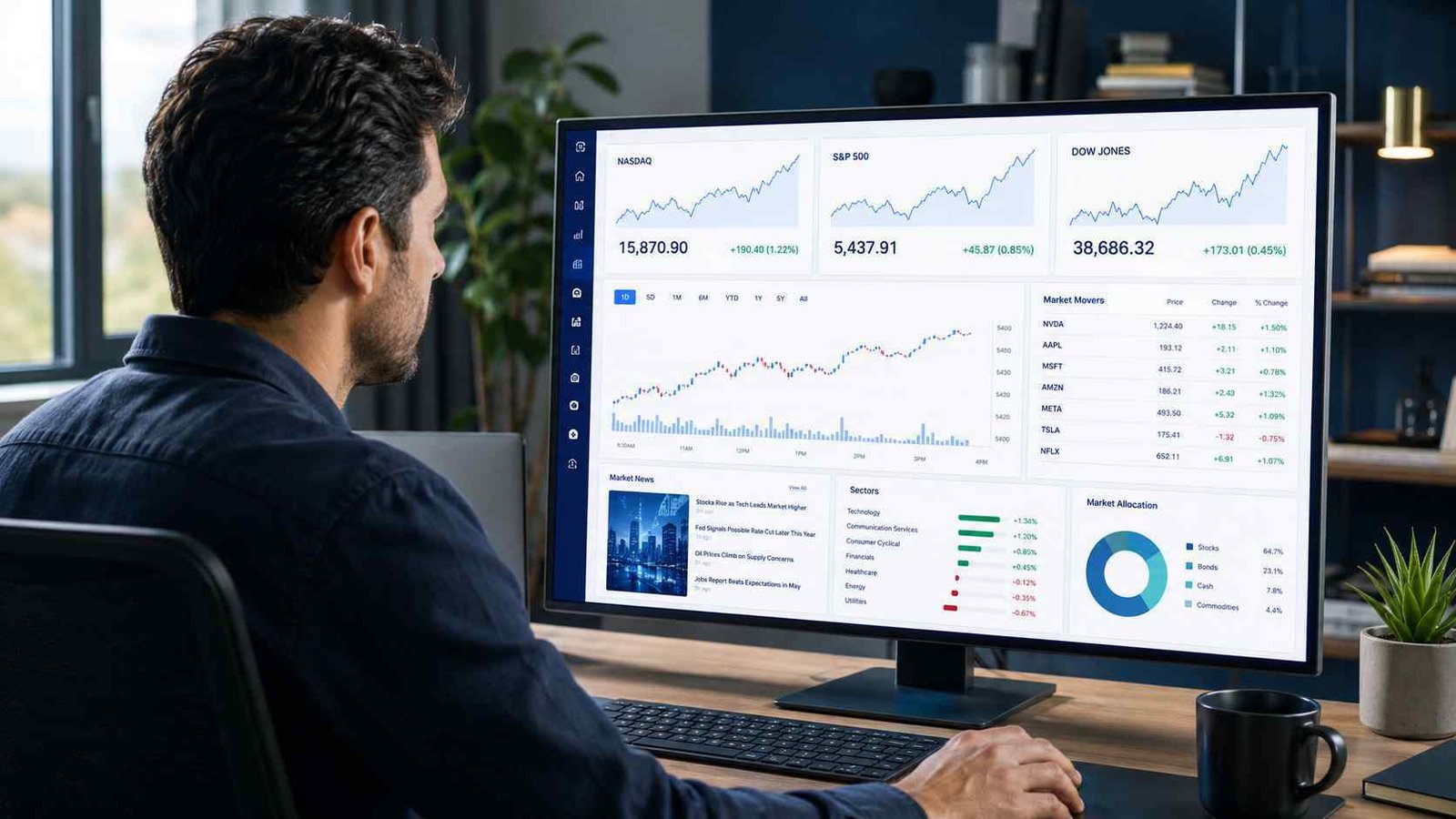

Most investors don’t have a research problem. They have a noise problem.
There is no shortage of market updates, stock tips, index trackers, or financial news feeds. What most people actually need is a platform that cuts through the clutter and explains what is happening in markets without requiring a finance degree to follow along.
FintechZoom stock market coverage works around that idea, bringing real-time data, index tracking, stock analysis, and financial news together in one place, written for people who invest their own money rather than manage it for others.
This guide covers how FintechZoom approaches stock market research, which tools are worth using, who gets the most value from the platform, and where it falls short. No platform covers everything, and knowing the limits of a resource matters just as much as knowing its strengths.
Table of Contents
How FintechZoom Covers the Stock Market
FintechZoom stock market coverage provides real-time stock data, index tracking, financial news, and market analysis for retail investors. It tracks major indices including the Nasdaq, S&P 500, Dow Jones, and the Russell 2000 alongside individual stocks, commodities, and international markets, giving everyday investors a single place for stock market research and context.
At the broadest level, coverage starts with the major U.S. equity indices. The Nasdaq Composite, S&P 500, and Dow Jones Industrial Average are tracked with regular updates and contextual commentary. What separates this from a simple data feed is the explanation layer. It does not just show where an index closed. The coverage explains why it moved, what drove the session, and what economic factors are currently in play. For a retail investor trying to understand cause and effect rather than just final numbers, that distinction is genuinely useful.
Individual stock coverage follows the same pattern. Companies like Apple, Tesla, Nvidia, Microsoft, and Alphabet receive dedicated attention through earnings breakdowns, price movement analysis, and sector context. Coverage is not limited to familiar names either. Smaller companies and emerging players get attention when market events warrant it, though depth varies depending on how much traffic a particular stock attracts.
International markets are part of the picture too. FintechZoom tracks the FTSE 100, Nikkei 225, DAX, and Shanghai Composite alongside U.S. indices, which matters for investors who want a global view rather than a purely American one. When Asian markets sell off overnight or European equities show unexpected strength, that context shows up in the coverage before U.S. markets open.
One thing that stands out is how the platform connects asset classes. When interest rates shift, coverage addresses what that means for equity valuations. When oil prices spike, articles explain the downstream effect on energy stocks and the broader S&P 500. That cross-asset perspective is something many financial platforms miss by siloing markets into separate, disconnected categories.
FintechZoom and the Major Market Indices
Stock market research on FintechZoom largely revolves around three indices. Each gets its own coverage pattern, and understanding how the platform approaches each one helps investors know where to look depending on what they are tracking.
Nasdaq Composite
This is where coverage is deepest. Technology companies dominate the Nasdaq, and FintechZoom’s own editorial focus on fintech and innovation aligns naturally with that concentration. Coverage includes major tech stock movements, semiconductor sector updates, earnings from companies like Alphabet, Meta, and Nvidia, and broader themes around cloud computing, artificial intelligence, and digital payments.
For someone tracking the technology sector specifically, this tends to be the most thorough area. Articles connect individual stock movements to wider industry trends rather than reporting price changes in isolation, which gives the coverage more analytical weight than a straightforward data feed. For a complete breakdown of the index itself, see our FintechZoom Nasdaq guide.
S&P 500
The S&P 500 receives consistent attention as the benchmark most retail investors use to measure overall market health. FintechZoom publishes regular analysis of index movements, sector rotation patterns, and the macro factors driving performance at the index level. Coverage frequently connects S&P movements to economic signals like inflation data, employment reports, consumer confidence numbers, and Federal Reserve commentary. For a full look at what moves the S&P 500 and how to track it, see our FintechZoom.com SP500 guide.
Dow Jones Industrial Average
The Dow features in coverage primarily as a reference point for blue-chip sentiment and longer-term trend analysis. Because the index is price-weighted and concentrated in thirty large established companies, its movements tell a different story from the broader S&P 500. FintechZoom’s coverage reflects that distinction rather than treating all three indices as interchangeable, which is a more accurate way to present them. For a complete breakdown of how the index works and what drives it, see our FintechZoom.com Dow Jones guide.
Global Indices
Beyond U.S. markets, FintechZoom tracks international benchmarks including the FTSE 100, Nikkei 225, DAX, and Shanghai Composite. Coverage of these markets is less frequent than U.S. index analysis but provides useful context for investors interested in global diversification or tracking how overnight developments in Asian and European markets might influence the U.S. open.
Using FintechZoom for Stock Market Research
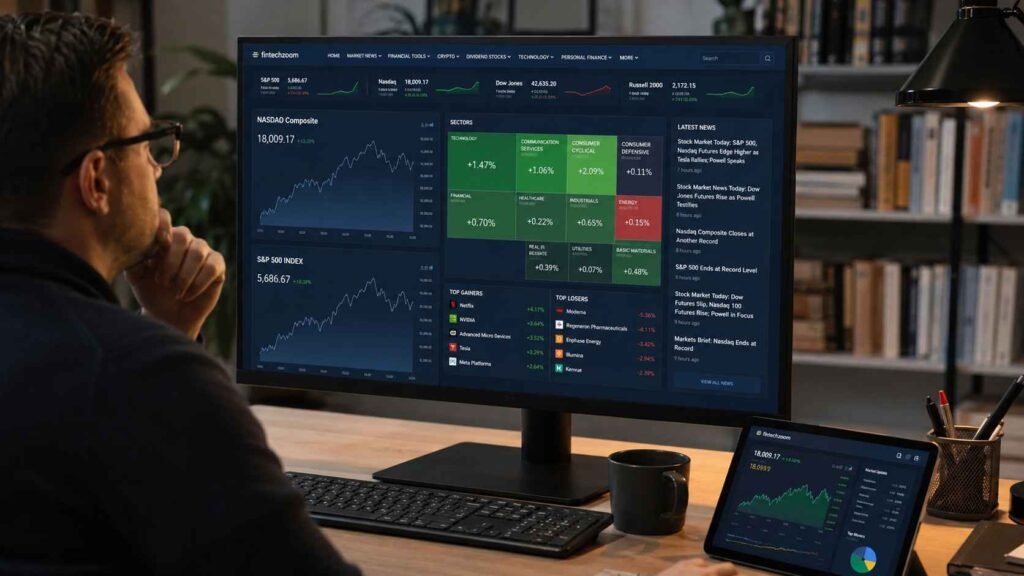
Most financial platforms give you either data or context. Rarely both. This is where FintechZoom finds its footing for stock market research, combining live price feeds with editorial analysis that explains what the numbers actually mean.
Live Price Feeds and Market Data
Stock prices, index movements, and sector performance update in real time during market hours. For someone tracking a position or monitoring broader market direction throughout the day, having that data readily accessible without a separate terminal saves time and reduces friction in the research process.
Stock Specific Analysis
Beyond raw numbers, the platform publishes earnings breakdowns, price movement analysis, and sector context around individual stocks. This layer of explanation matters for investors trying to understand why a stock moved, not just by how much.
Market News in Context
Breaking financial news sits alongside market data rather than in a separate section. When a Fed decision drops or an earnings report surprises the market, coverage connects the event directly to price movements. That connection is what turns news into useful research rather than just background noise.
Educational Resources for Stock Investors
Concepts like price-to-earnings ratios, market cycles, support and resistance levels, and sector rotation are explained throughout the platform. For investors still building their knowledge base, this removes the need to leave the site every time an unfamiliar term appears in an article.
Who Benefits Most From FintechZoom Stock Market
Not every investor gets the same value from this platform. It depends entirely on what you need from a stock market research tool and where you are in your investing journey.
Retail investors who actively follow markets but do not want to pay for institutional grade tools will find the most practical value here. The combination of live data, stock analysis, and financial news covers enough ground for informed decision making without a subscription fee.
Investors who are still learning how markets work benefit from a different angle. Stock prices do not move in isolation. They respond to earnings, interest rates, sector trends, and broader economic conditions. Having all of that context in one place accelerates understanding in a way that isolated data feeds simply do not.
For investors who follow both traditional equities and other asset classes like crypto or commodities, the cross market coverage is genuinely useful. Spotting correlations between markets in real time requires seeing them together, and this platform makes that possible without switching between tools.
Where the fit weakens is at the professional end. Institutional investors, quantitative analysts, and active day traders who depend on raw data precision, advanced modeling, or high frequency feeds will find the platform too general for their needs. It was not built for that level of depth, and no amount of creative use changes that.
Most serious investors who use it at all treat it as one layer in a broader research stack, not the entire foundation.
How FintechZoom Fits Into a Modern Investor’s Research Workflow

Most articles about FintechZoom list its features and stop there. What they skip is the part that actually matters: how a real investor uses it inside a research process that involves multiple tools and sources. Features mean nothing without context for how they fit together.
Starting a Research Session
FintechZoom works best at the beginning. Before opening a stock screener, reading an earnings report, or checking a brokerage account, a quick scan of the latest market updates gives you the macro environment. What moved overnight, which sectors are leading, what economic data dropped this morning, and what the overall market tone looks like. That orientation takes five minutes and sets the context for everything that follows.
Skipping this step is a common mistake. Researching an individual stock without knowing what the broader market is doing is like reading one chapter of a book without knowing the story. FintechZoom fills that gap quickly.
Following News During Volatile Sessions
When markets move sharply during the trading day, the real-time news feed earns its place. If a stock you hold drops three percent in an hour, the platform will often have coverage explaining the catalyst faster than running a manual search across multiple outlets. That speed matters when you are trying to decide whether a move is noise or something worth acting on.
Where to Step Away
This is the part most investors figure out through experience rather than being told upfront. When research moves from context-gathering into primary source territory, FintechZoom hands off to other tools.
Earnings reports, SEC filings, and detailed financial statements require going directly to a company’s investor relations page or the SEC’s EDGAR database. Analyst price targets and institutional research notes live on platforms like Seeking Alpha, FactSet, or directly through a brokerage. Advanced technical analysis belongs on a dedicated charting platform.
It summarizes and contextualizes information from these sources. It does not replace them.
Cross-Referencing
No single financial media platform should be the only voice in any research process. FintechZoom reflects the interpretation of its editorial team, as every outlet does. Comparing coverage of the same market event across two or three sources gives a more complete and balanced picture. This applies equally to every financial news source, including the most established ones.
Used this way, it functions effectively as one layer in a broader process. A strong starting point, a useful news monitor, and a readable context engine. Not the entire research stack, but a valuable part of it.
Limitations of Using FintechZoom for Stock Market Research
Every research tool has boundaries. Knowing where this one ends helps you use it more effectively rather than expecting something it was never designed to deliver.
Not a Substitute for Primary Sources
Market analysis and news summaries are useful for orientation but they are not replacements for original data. Earnings reports, SEC filings, and official exchange data require going directly to the source. FintechZoom contextualizes that information. It does not replace it, and treating it as a primary source for investment decisions is a misuse of what it actually offers.
Depth Varies Across Stocks
High traffic stocks like Apple, Tesla, and Nvidia receive detailed, regular coverage. Less followed companies and smaller cap stocks get significantly less attention. Investors researching outside the most actively traded names will hit coverage gaps that require filling from elsewhere.
No Portfolio Tracking
There is no way to link a brokerage account, log positions, or monitor overall portfolio performance through the platform. For that functionality a dedicated portfolio management tool is needed alongside it.
Source Attribution Is Inconsistent
Some articles lack clearly named authors or detailed source citations. For stock market content where decisions carry financial consequences, that matters. Cross referencing specific claims with primary sources before acting on them is always advisable.
Data Precision Has Limits
Live price feeds are useful for general monitoring but are not built for the millisecond precision that active trading strategies require. Dedicated trading platforms and direct exchange feeds offer a level of accuracy this platform was not designed to match.
Understanding these boundaries does not diminish what FintechZoom offers for stock market research. It simply clarifies where it fits and where something else needs to take over.
FintechZoom in the Age of AI-Driven Market Information
The way investors find and consume market information has changed significantly over recent years, and the pace of that change is still accelerating. Understanding where FintechZoom sits inside that shift matters for anyone deciding how much weight to give it in their research process.
How AI Search Is Changing Financial Research
Google’s AI Overviews and AI Mode have fundamentally altered how many people arrive at financial information. A growing portion of stock market queries now return AI-generated summaries directly on the search results page, before a user clicks anywhere. For financial media platforms, this creates a real visibility challenge. Content that is clearly sourced, well-structured, and answers questions directly tends to get cited in AI-generated responses. Thin content, poorly attributed articles, and keyword-stuffed summaries get filtered out.
Where FintechZoom Stands
Its editorial approach, which combines accessible explanation with market context, positions it reasonably well in this environment. Articles that answer direct questions quickly and connect market events to broader financial themes align with how AI sourcing systems select content. The transparency issues noted in the previous section work against it though. AI sourcing systems increasingly favor verifiable claims, named authorship, and primary source attribution.
Why Human Context Still Matters
As automated tools multiply and raw data becomes increasingly commoditized, the value of clear explanation and readable market context does not shrink. It arguably grows. An investor drowning in AI-generated summaries and data feeds still needs someone to explain what a yield curve inversion actually means for their portfolio, or why a single Fed comment sent markets down two percent in an afternoon.
That is the space FintechZoom occupies. Not the data layer, not the algorithmic signal layer, but the explanation layer. In a research environment where everything else is becoming more automated, that layer has a durable place.
Frequently Asked Questions About FintechZoom Stock Market
What does FintechZoom stock market cover? FintechZoom stock market covers real-time price data, index tracking, stock specific analysis, and financial news across major U.S. and international markets. Coverage includes the Nasdaq, S&P 500, and Dow Jones alongside individual stocks and sector trends.
How is FintechZoom useful for stock market research? It combines live market data with editorial analysis, giving investors both the numbers and the context behind them. It works best as an orientation layer at the start of a research session before going deeper into primary sources.
Does FintechZoom cover international stock markets? Yes. Alongside U.S. indices, it tracks major international benchmarks including the FTSE 100, Nikkei 225, DAX, and Shanghai Composite.
Is FintechZoom suitable for beginner stock investors? Yes. The platform explains market concepts in accessible language and covers the connections between economic events and stock price movements, making it practical for investors still building their market knowledge.
Can FintechZoom replace a stock broker or financial advisor? No. It is an information and research platform. It does not execute trades, manage portfolios, or provide personalized financial advice. Those functions require a licensed broker or qualified financial advisor.
How current is the stock market data on FintechZoom? Price feeds update in real time during market hours. The data is suited for general research and market monitoring rather than high frequency trading strategies that require institutional grade precision.
What stocks does FintechZoom cover most thoroughly? Coverage is deepest around high traffic names in technology, finance, and blue chip equities. Smaller cap and less actively traded stocks receive less consistent coverage, and investors focused on those areas may need to supplement with specialist sources.
Conclusion
FintechZoom stock market coverage fills a gap that most financial platforms either ignore or handle poorly. It takes market data, index movements, stock analysis, and financial news and presents them in a way that actual people can follow without a Bloomberg terminal or a finance degree.
For retail investors and beginners, that accessibility has real value. Understanding what is moving markets on any given day, why an index dropped, or what a Fed decision means for equities is genuinely useful knowledge. This coverage delivers that context consistently and in plain language.
For more experienced investors, it works best as one part of a broader research process. A quick morning scan, a news monitor during volatile sessions, a readable overview before going deeper elsewhere. Not the entire research stack, but a solid and reliable layer within it.
The limitations are real and worth respecting. It is not a trading platform. It is not a financial advisor. It does not replace primary sources, institutional data, or professional guidance. Investors who understand those boundaries will get far more out of it than those who treat it as a one-stop solution.
Markets reward preparation. FintechZoom is a practical tool for staying prepared, as long as you know exactly what kind of tool it is.
This article is for informational purposes only and does not constitute financial advice.